Tiresias
Single channel video
3:35 min
Festival Internacional de la Imagen, Bogotá y Manizales, Colombia 2026
FILE FESTIVAL Fiesp Cultural Centre, São Paulo 2026
CVPR Conference Art Gallery Denver 2026
29es Rencontres Internationales Traverse Toulouse 2026
THE WRONG New Digital Art Biennale 2026
arebyte BYOB London 2026
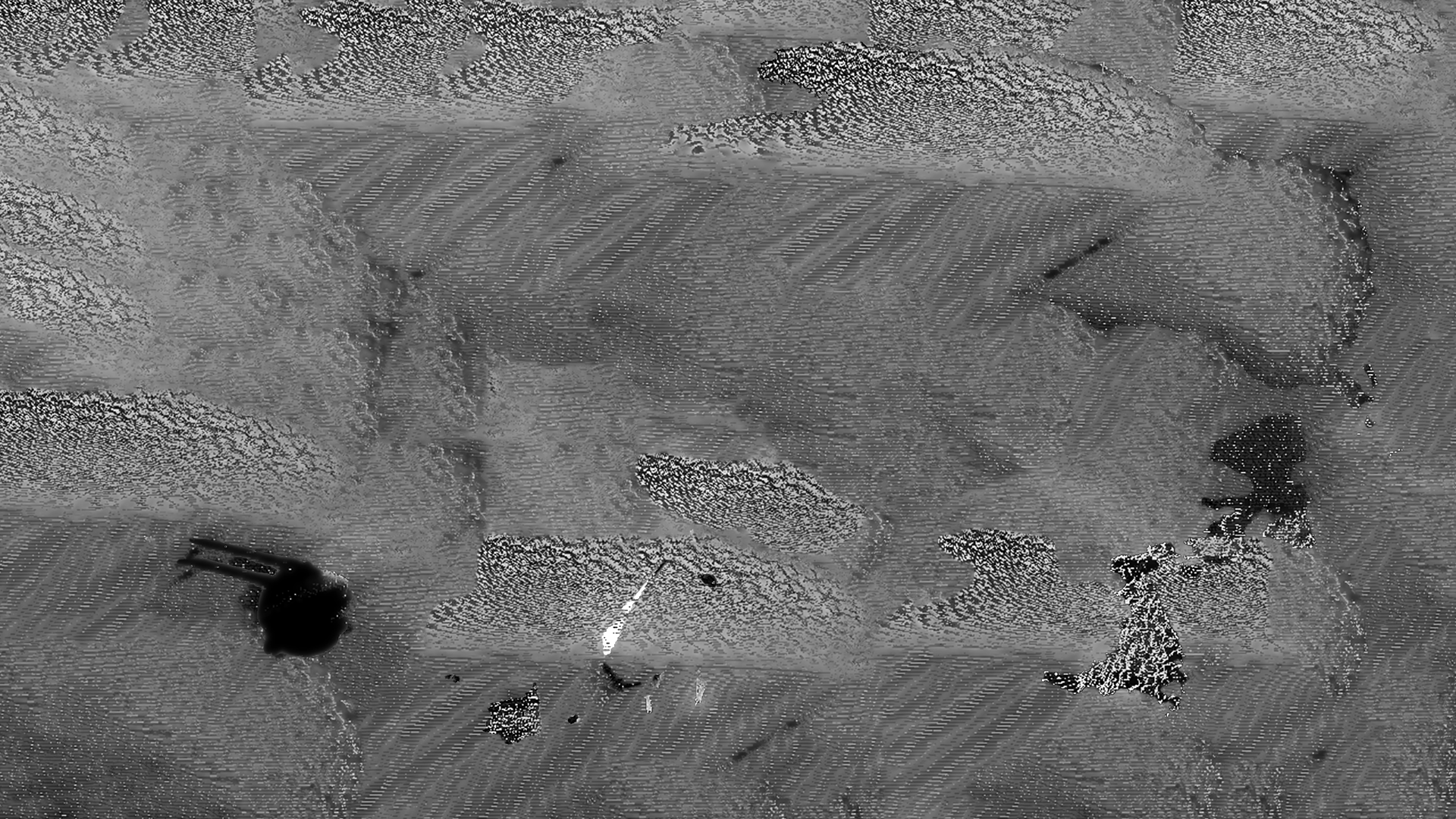
Tiresias is a meditation on seeing, foreseeing, and unseeing.
Inspired by the blind prophet of Greek mythology, the piece explores the loss of inner sight and machine seeing, interrogating GAN’s recursivity, as foresight collapses into repetition.
Tiresias can no longer see in the dark, because even the dark is gone. What once was darkness, a space of mystery, concealment, and prophecy, has been colonised by artificial reflection, saturated by images that endlessly reproduce themselves. Hypervisibility is a light that blinds. Images fold back on themselves, every surface reflects back another, until depth collapses and foresight dissolves. Mirrors reflecting mirrors, a bottomless gaze into void. This is false foresight, not the opening of possibility, but its narrowing, the past disguised as the future.
Created using GANs, TouchDesigner, volumetric capture, processing, and poetry, the work stages the impossibility of looking forward when the horizon has flattened and asks whether another kind of vision is possible: one that embraces uncertainty and holds space for what we cannot yet see, as only then it’s possible to escape the reflective blind stare.
Inspired by the blind prophet of Greek mythology, the piece explores the loss of inner sight and machine seeing, interrogating GAN’s recursivity, as foresight collapses into repetition.
Tiresias can no longer see in the dark, because even the dark is gone. What once was darkness, a space of mystery, concealment, and prophecy, has been colonised by artificial reflection, saturated by images that endlessly reproduce themselves. Hypervisibility is a light that blinds. Images fold back on themselves, every surface reflects back another, until depth collapses and foresight dissolves. Mirrors reflecting mirrors, a bottomless gaze into void. This is false foresight, not the opening of possibility, but its narrowing, the past disguised as the future.
Created using GANs, TouchDesigner, volumetric capture, processing, and poetry, the work stages the impossibility of looking forward when the horizon has flattened and asks whether another kind of vision is possible: one that embraces uncertainty and holds space for what we cannot yet see, as only then it’s possible to escape the reflective blind stare.